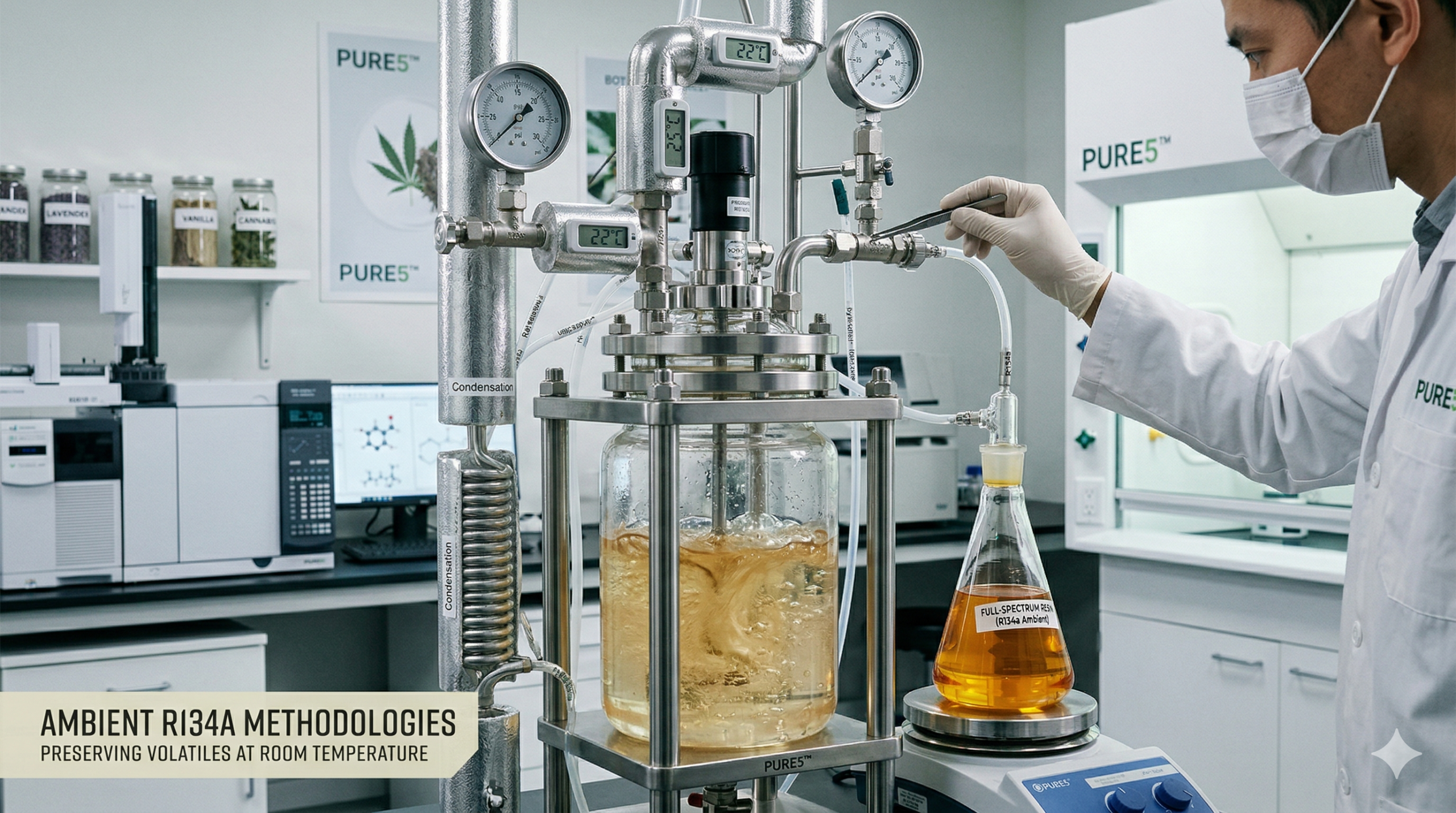
Discover how room-temperature extraction preserves volatile compounds that CO2 and Ethanol destroy.
For decades, the botanical extraction industry has been locked in a battle against thermodynamics. As scientists and commercial extractors, our ultimate goal has always been to capture the “living essence” of a plant—the exact phytochemical profile of cannabinoids, flavonoids, and fragile terpenes exactly as they exist in nature.
However, the legacy solvents that have dominated the industry—specifically Supercritical CO2 and Ethanol—fundamentally compromise this goal. By relying on extreme temperatures or aggressive pressures, these methods strip the plant of its most delicate therapeutic compounds.
To understand why Full Body Resin advocates for ambient temperature extraction, we must look at the organic chemistry of terpene degradation and how R134a (Tetrafluoroethane) methodology provides an elegant, scientifically sound solution.
The Physics of Terpene Degradation
The medicinal value and sensory experience of a full-spectrum botanical extract rely heavily on monoterpenes and sesquiterpenes. These molecules are highly volatile. When subjected to the thermal stress required to recover ethanol, or the extreme pressure changes inherent in CO2 extraction, these compounds undergo isomerization, oxidation, or complete evaporation.
From a kinetic standpoint, the rate of chemical degradation is exponentially dependent on temperature, as described by the Arrhenius equation:
Where $T$ is the absolute temperature. Simply put: the application of heat during extraction or post-processing solvent recovery exponentially accelerates the destruction of your highest-value botanical compounds.
What is Ambient R134a Extraction?
R134a (1,1,1,2-Tetrafluoroethane) is an FDA-approved, non-flammable, and non-toxic aerosol propellant commonly used in medical asthma inhalers.
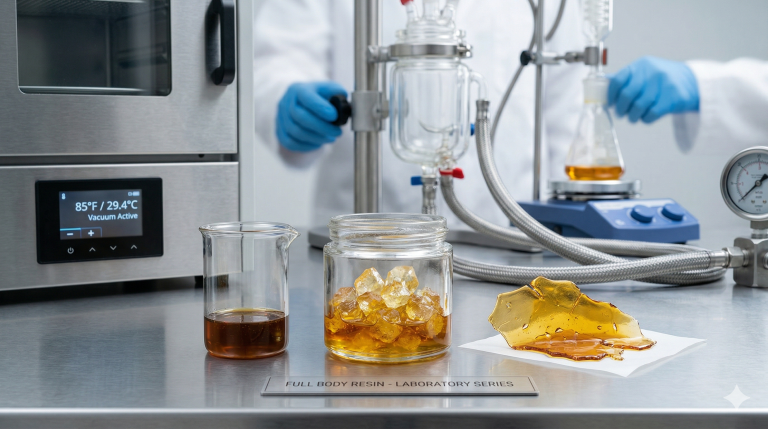
In botanical extraction, R134a operates as a liquefied gas solvent at ambient room temperature (approx. 20°C to 25°C) and low pressure. Because its boiling point is incredibly low (-26.3°C), it effortlessly transitions back into a gas during the recovery phase without the need to boil the remaining resin.
The Chemical Advantage: R134a is uniquely selective. Its polarity is perfectly tuned to target lipophilic (fat-soluble) resins, cannabinoids, and essential oils, while actively ignoring water-soluble plant matter like chlorophyll, salts, and heavy waxes.
The Ultimate Comparison: R134a vs. Legacy Solvents
To truly understand the paradigm shift of ambient extraction, we must benchmark it against the current industry standards.
| Feature | Supercritical CO2 | Cryo-Ethanol | Ambient R134a |
| Operating Temperature | Extreme variations (Often high heat for recovery) | Deep freezing (-40°C) to high heat for recovery | Room Temperature (20°C – 25°C) |
| Operating Pressure | Extremely High (1500 – 5000+ psi) | Atmospheric | Low (approx. 60 – 80 psi) |
| Terpene Retention | Poor (Often requires separate subcritical runs) | Moderate (Thermal degradation during purge) | Exceptional (Near 100% preservation) |
| Post-Processing Needed | Winterization (Ethanol washing) required to remove waxes | Activated carbon filtration / aggressive purging | None. Ready to formulate. |
| Selectivity | Co-extracts heavy waxes and lipids | Polar nature co-extracts chlorophyll and water | Highly selective for resins and oils only |
Bridging the Gap: The PURE5™ Implementation
The theoretical superiority of R134a means nothing without commercial scalability. This is where advanced engineering bridges the gap between the laboratory and the manufacturing floor.
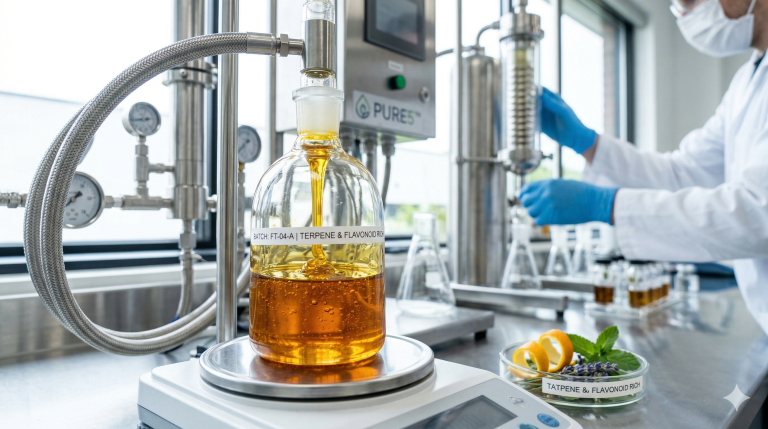
Using PURE5™ Extraction technology, the R134a methodology is deployed in a continuous, closed-loop system. The process washes the raw botanical biomass at room temperature, gently dissolving the full-spectrum resin. During the separation phase, the R134a gently evaporates away from the extract at ambient temperatures, leaving behind a pure, uncompromised, “solventless-quality” resin.
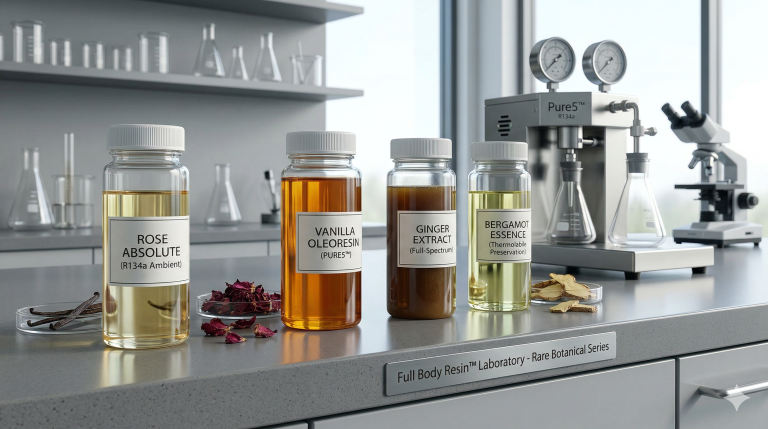
Because the solvent recovery happens without a thermal vacuum oven, the lighter volatile compounds—such as Hashishene or highly volatile citrus monoterpenes—remain locked into the final oil.
The Bottom Line for Full-Spectrum Content
A true “full-spectrum” product is not merely a marketing buzzword; it is a measurable chemical reality. If your extraction method requires you to boil off your solvent, you are boiling off your profits and your plant’s biological integrity.
Ambient R134a extraction is not just an alternative method; it is the evolutionary next step in botanical science. By respecting the thermodynamics of the plant, we can finally extract commercial-scale resins that perfectly mirror the living botanical profile.