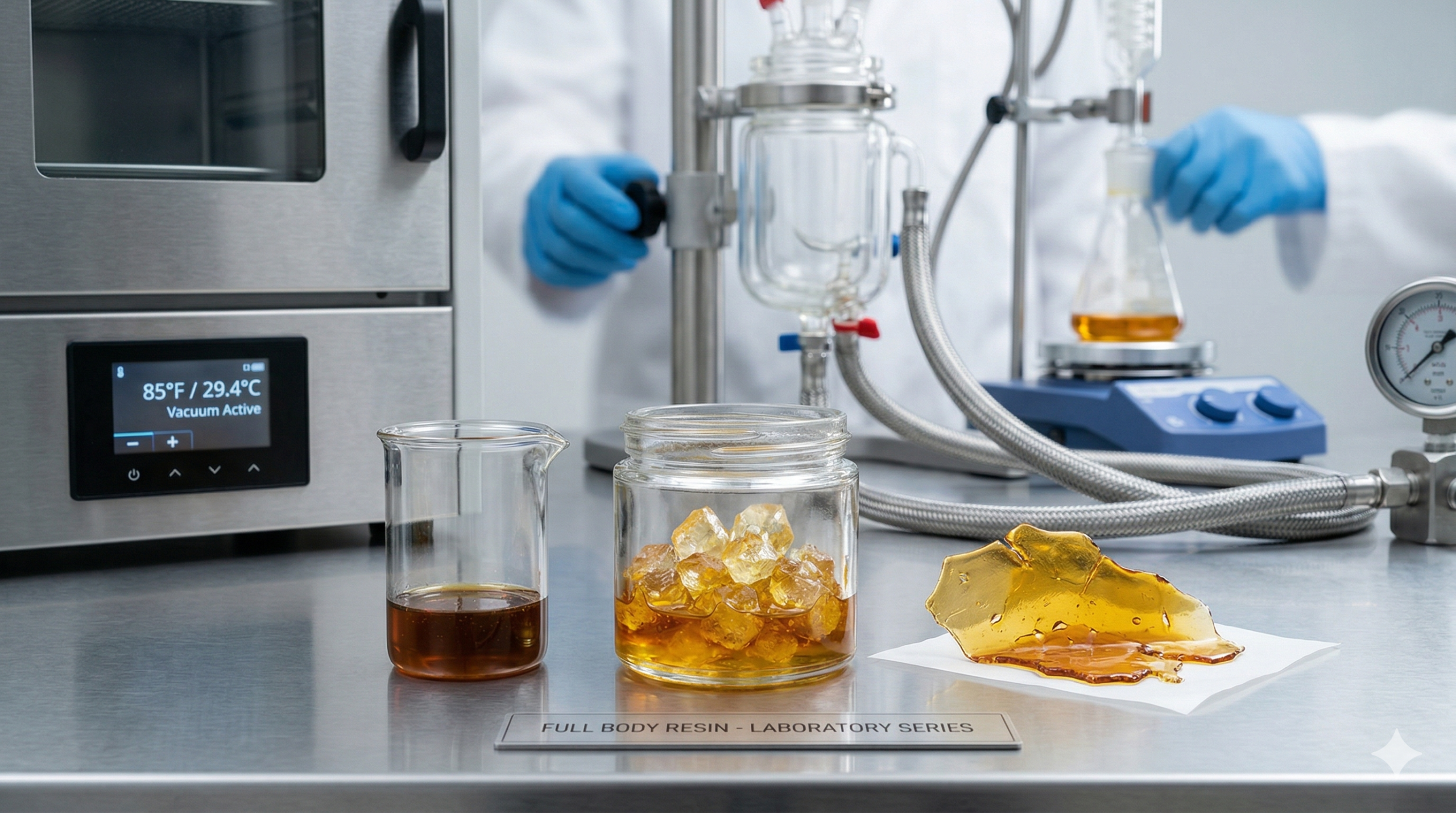
Refining crude resin into premium diamonds, sauce, and shatter using low-heat techniques.
Introduction
In modern cannabis extraction, producing high-quality crude is no longer the final benchmark—it is merely the starting point. The true differentiation in premium products lies in post-processing excellence, where crude resin is transformed into refined formats such as THCA diamonds, terpene-rich sauce, and glass-like shatter.
This transformation is not simply mechanical; it is a controlled chemical and microbiological process, where temperature, pressure, solvent behavior, and molecular stability must be precisely managed. Increasingly, leading processors are shifting toward low-heat refinement techniques, prioritizing compound preservation over aggressive purification.
Understanding Crude Resin: Composition and Challenges
Crude cannabis resin is a complex, multi-phase matrix containing:
- Cannabinoids (THCA, CBDA, minor cannabinoids)
- Terpenes (volatile and semi-volatile fractions)
- Lipids, waxes, and pigments
- Residual solvents (depending on extraction method)
- Microbial remnants and water activity traces
From a processing standpoint, crude resin is:
- Chemically unstable
- Highly reactive under heat
- Sensitive to oxidation and terpene loss
The goal of post-processing is not simply to “clean” this matrix—but to selectively reorganize it into high-value fractions without degrading its functional compounds.
The Shift Toward Low-Heat Processing
Traditional refinement methods often rely on:
- High-temperature distillation
- Aggressive solvent purging
- Rapid evaporation
While effective for purification, these approaches:
- Destroy volatile terpenes
- Degrade minor cannabinoids
- Flatten the biochemical profile
Low-heat processing, by contrast, focuses on:
- Thermodynamic control rather than force
- Preservation of native molecular relationships
- Gradual phase separation instead of rapid fractionation
This aligns closely with modern botanical extraction philosophy—similar to how high-end resin materials preserve detail through controlled curing rather than aggressive treatment .
THCA Diamonds: Controlled Crystallization
Formation Mechanism
THCA diamonds are formed through supersaturation and nucleation within a hydrocarbon-rich solution.
Key variables:
- Solvent saturation level
- Temperature stability (typically low and constant)
- Pressure within sealed systems
Under controlled conditions:
- THCA molecules self-assemble into crystalline lattices
- Remaining liquid becomes terpene-rich “mother liquor” (sauce)
Low-Heat Advantage
Using low temperatures:
- Prevents premature decarboxylation (THCA → THC)
- Preserves crystal clarity and structure
- Maintains terpene integrity in surrounding sauce
Engineering Insight
Diamond formation is essentially:
- A slow kinetic process, not a forced separation
- Dependent on time, not temperature
Operators who rush this step with heat often:
- Collapse crystal structure
- Lose terpene fractions
- Produce inferior “sugar” instead of diamonds
Sauce: The Terpene-Rich Fraction
Sauce (or “HTFSE” – High Terpene Full Spectrum Extract) is the liquid phase remaining after crystallization.
Composition
- High terpene concentration (often 10–40%)
- Dissolved minor cannabinoids
- Residual solvent traces (must be carefully purged)
Role in the Entourage Effect
Sauce is critical because:
- Terpenes act as bioactive modulators
- Enhance absorption and receptor interaction
- Contribute to strain-specific effects
Low-Heat Processing Benefits
- Preserves monoterpenes (highly volatile)
- Prevents oxidation into less active compounds
- Maintains true-to-strain aromatic profile
From a microbiological perspective:
- Many terpenes exhibit natural antimicrobial properties
- However, improper handling can still introduce contamination
Thus, closed-loop environments and controlled humidity are essential.
Shatter: Amorphous Stability Through Control
Shatter represents a different pathway—rather than crystallization, it is about preventing crystallization entirely.
Structural Characteristics
- Amorphous (non-crystalline) cannabinoid matrix
- Glass-like transparency
- Brittle texture
Formation Requirements
- Rapid solvent removal
- Controlled agitation (minimal disturbance)
- Stable low-temperature environment
Low-Heat Importance
Excess heat causes:
- Nucleation → “sugaring” (loss of shatter form)
- Terpene evaporation
- Structural instability
Low-heat purging ensures:
- Uniform molecular distribution
- Long-term stability
- Preservation of flavor profile
Microbiological Considerations in Post-Processing
While extraction reduces microbial load, post-processing introduces new risks:
Critical Risk Factors
- Residual moisture (water activity)
- Oxygen exposure
- Handling contamination
- Equipment biofilm formation
Low-Heat Trade-Off
Unlike high-heat distillation (which sterilizes), low-heat methods require:
- Stricter upstream biomass quality
- Sanitary design (CIP/SIP systems)
- Controlled environments (cleanroom conditions)
However, preserved terpenes can contribute to:
- Natural antimicrobial resistance
- Improved shelf-life when properly stored
Equipment & Process Optimization
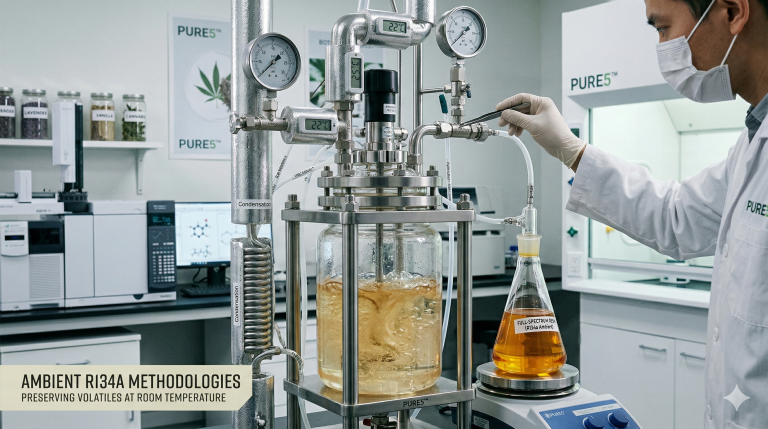
Achieving consistent premium outputs requires:
1. Closed-Loop Hydrocarbon Systems
- Precise solvent recovery
- Minimal exposure to oxygen
2. Jacketed Vessels & Controlled Environments
- Stable temperature gradients
- Reduced thermal shock
3. Vacuum Ovens (Low-Temp Operation)
- Controlled solvent purge
- Prevention of terpene loss
4. Pressure-Stable Crystallization Vessels
- Essential for diamond formation
- Enable slow, controlled nucleation
Comparative Output: Diamonds vs Sauce vs Shatter
| Parameter | Diamonds | Sauce | Shatter |
|---|---|---|---|
| Structure | Crystalline | Liquid | Amorphous solid |
| Terpene Content | Low (in crystal) | Very high | Moderate |
| Processing Time | Long | Medium | Short |
| Heat Sensitivity | Very high | Extremely high | High |
| Stability | High | Medium | Medium |
Each product represents a different manipulation of the same crude resin, guided by:
- Thermodynamics
- Kinetics
- Process control precision
The Future of Post-Processing
The industry is moving toward:
- Solventless crystallization techniques
- Terpene fraction preservation systems
- AI-controlled process environments
- Pharmaceutical-grade refinement standards
The focus is shifting from:
- “How pure can we make it?”
to: - “How intact can we keep the plant’s chemistry?”
Conclusion
Post-processing is where cannabis extraction becomes a true engineering discipline.
Through low-heat techniques, processors can transform crude resin into:
- Structurally perfect THCA diamonds
- Biochemically rich terpene sauce
- Stable, high-clarity shatter
All while preserving the delicate balance of compounds that define quality, efficacy, and consumer experience.
In high-end extraction, excellence is no longer defined by purity alone—but by how much of the plant’s original complexity survives the process.