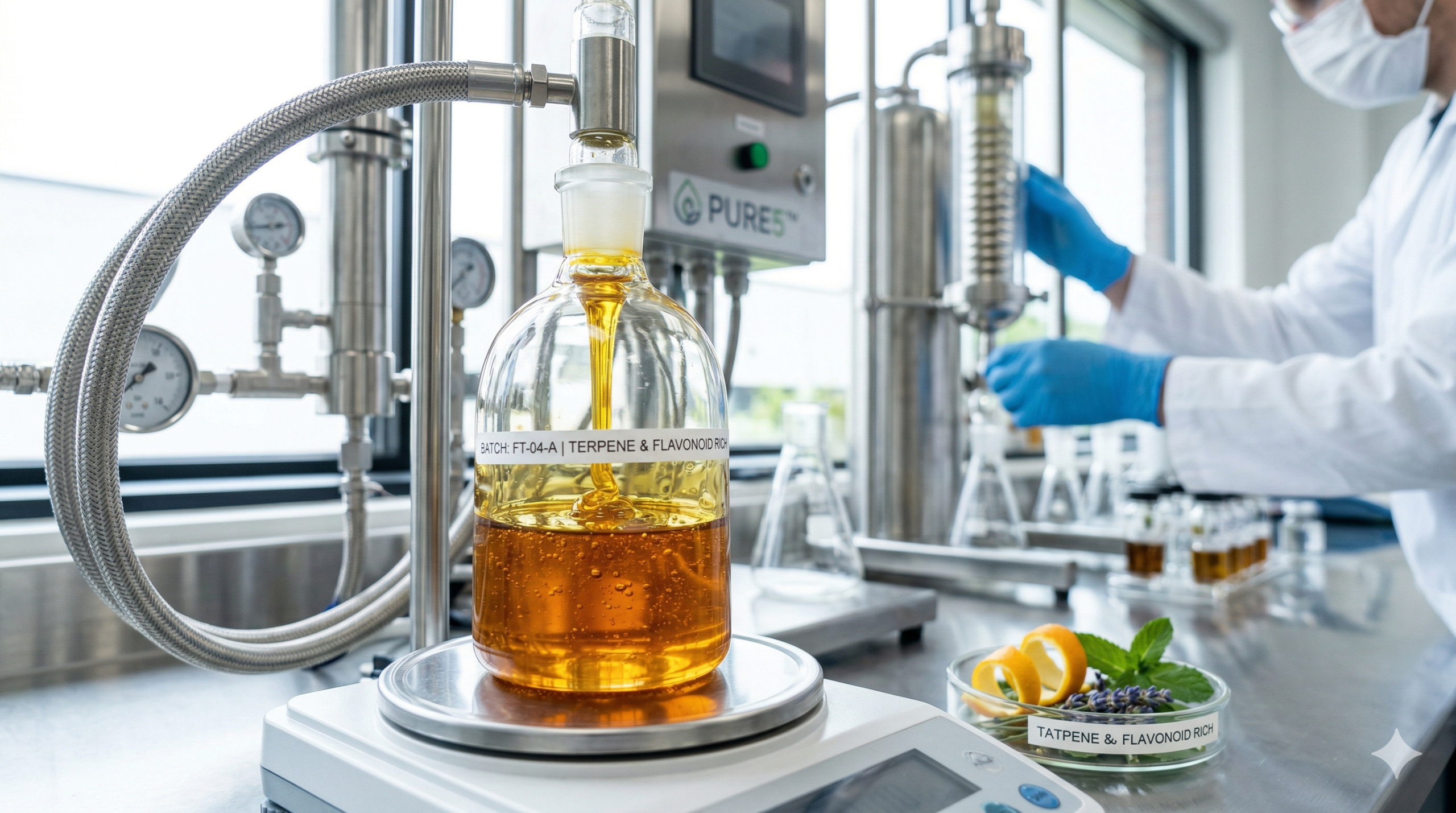
A scientific look at the boiling points of essential oils and how to prevent thermal degradation.
In the pursuit of creating true full-spectrum botanical extracts, the industry often focuses heavily on cannabinoid or primary alkaloid yields. However, from a pharmacological and commercial standpoint, the true value of an extract lies in its volatile organic compounds (VOCs)—specifically, terpenes and flavonoids. These delicate molecules govern the aroma, flavor, and the highly sought-after “entourage effect” that defines premium resin.
Unfortunately, conventional extraction and solvent recovery methodologies rely heavily on thermal manipulation. This introduces a critical flaw in the manufacturing pipeline: thermal degradation.
To master terpene and flavonoid retention, we must approach extraction not just as a mechanical process, but as an exercise in physical chemistry and thermodynamics.
The Thermodynamics of Essential Oils
Terpenes are hydrocarbon compounds synthesized in the trichomes and glandular structures of botanicals. They are categorized by their isoprene units. Monoterpenes (like myrcene, $\alpha$-pinene, and limonene) are highly volatile, while sesquiterpenes (like caryophyllene) are slightly heavier. Flavonoids, which contribute to the pigmentation and antioxidant profile of the plant, are similarly sensitive to environmental stress.
A common misconception in botanical extraction is that terpenes are safe as long as the processing temperature remains below their literal boiling points (which typically range from 150°C to 200°C for monoterpenes). This ignores the fundamental physics of vapor pressure.
The relationship between temperature and the vapor pressure of a liquid is described by the Clausius-Clapeyron equation:
Where $\Delta H_{vap}$ is the enthalpy of vaporization, $R$ is the ideal gas constant, and $T$ is absolute temperature.
This equation dictates that as temperature increases, the vapor pressure of essential oils increases exponentially. Therefore, significant evaporation and off-gassing of monoterpenes occur at temperatures far below their actual boiling points. When a botanical matrix is exposed to the 40°C to 60°C heat commonly used in ethanol purging or winterization, the lighter, highly volatile compounds are systematically driven off, flattening the final full-spectrum profile.
The Mechanisms of Thermal Degradation
When heat is introduced to a botanical resin, evaporation is only the first mode of failure. Thermal energy acts as a catalyst for destructive chemical reactions that permanently alter the biological integrity of the extract.
- Isomerization: Heat can cause double bonds within terpene structures to shift, converting highly therapeutic terpenes into less desirable isomers. This changes the sensory profile and degrades the medicinal efficacy.
- Oxidation: Elevated temperatures exponentially accelerate the oxidation rate of essential oils when exposed to trace amounts of oxygen. This leads to the darkening of the resin and the creation of harsh, degraded byproducts (e.g., the conversion of delicate terpenes into terpenoids with bitter flavor profiles).
- Flavonoid Denaturation: Flavonoids are incredibly sensitive to both heat and extreme pH shifts. High-temperature processing destroys these compounds, stripping the final extract of its natural color and auxiliary antioxidant benefits.
The Conventional Bottleneck: CO2 and Ethanol
The thermal degradation problem is inherent to the solvent recovery phases of legacy extraction methods.
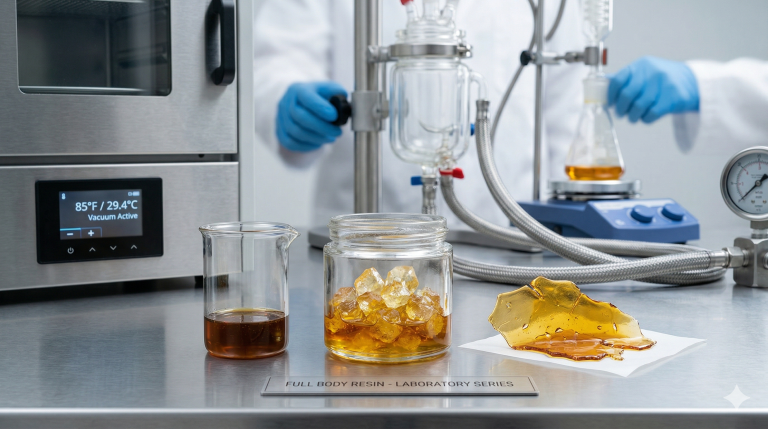
Ethanol extraction is highly polar and efficient at stripping biomass, but separating the ethanol from the botanical resin requires either a heated vacuum oven or a rotary evaporator. Even under deep vacuum, the thermal energy required to boil off ethanol actively strips the monoterpenes from the crude oil.
Supercritical CO2 utilizes extreme pressures (often exceeding 2,000 psi) to manipulate the solvency of carbon dioxide. The sheer mechanical friction and the phase-change temperature swings required during separation fundamentally damage the delicate trichome heads and flavonoid structures, resulting in a muted, incomplete extract.
The Ambient Solution: Preventing Degradation
To achieve 100% terpene and flavonoid retention, the extraction and recovery process must operate below the thermodynamic threshold where vapor pressure and oxidation become liabilities. This is the core scientific thesis behind ambient-temperature methodologies, such as those utilizing R134a.
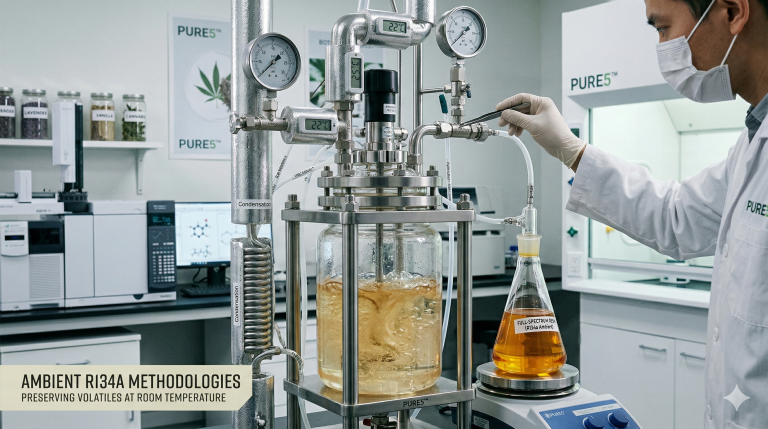
By leveraging a solvent with an extremely low boiling point (-26.3°C), the entire lifecycle of the extraction—from washing the biomass to purging the final resin—can occur at standard room temperature (20°C – 25°C).
Because the R134a solvent evaporates away from the extracted resin naturally at ambient temperature, no external heat is required. The Clausius-Clapeyron curve is bypassed entirely. The monoterpenes are never subjected to the thermal energy required for them to break their liquid bonds, and the flavonoids remain biologically intact.
Conclusion: Chemistry Equals Profitability
In the modern botanical market, educated consumers and pharmaceutical formulators demand true full-spectrum concentrates. They are looking for the exact chemical fingerprint of the living plant.
By understanding the boiling points and vapor pressures of essential oils, facilities can transition away from destructive thermal purging. Utilizing ambient methodologies preserves the fragile ecosystem of terpenes and flavonoids, ensuring that the highest-value compounds end up in the final product, rather than evaporated into the atmosphere of the laboratory.