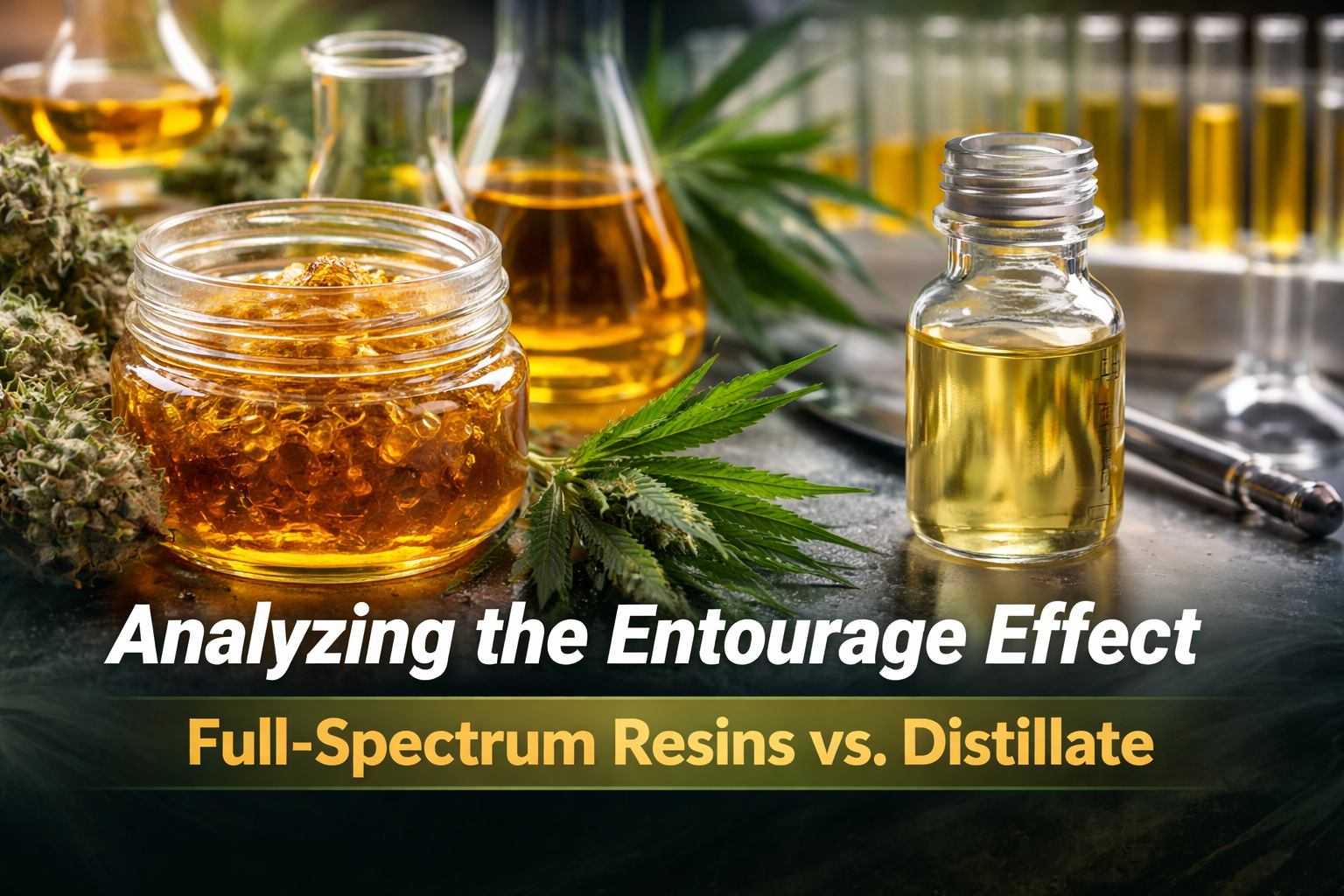
Analyzing the entourage effect in full-spectrum resins compared to traditional distillate.
Introduction
As cannabis and hemp extraction technologies evolve, the industry is increasingly shifting from purity-focused distillates toward complex, full-spectrum resin products. This transition is driven by a deeper understanding of plant biochemistry—particularly the concept known as the entourage effect.
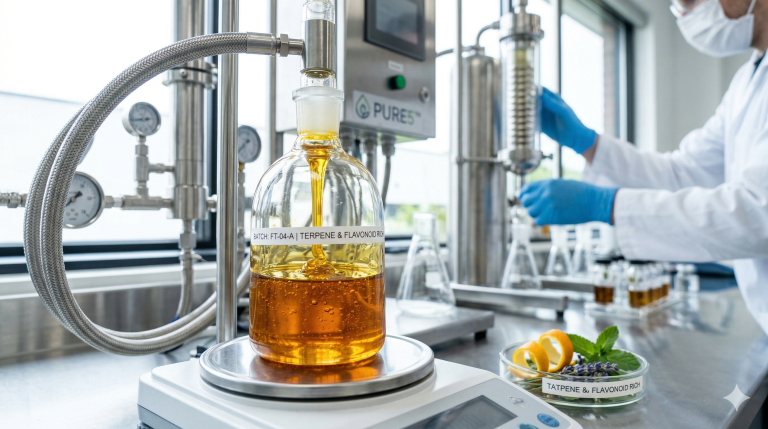
Rather than isolating a single cannabinoid such as THC or CBD, full-spectrum resins preserve a broad matrix of cannabinoids, terpenes, flavonoids, lipids, and minor phytochemicals. These compounds interact synergistically, creating effects that differ fundamentally from those produced by traditional distillates.
This article explores the entourage effect from a scientific, extraction, and microbiological perspective, highlighting why full-spectrum resins are redefining quality in modern cannabis processing.
What Is the Entourage Effect (Scientific Perspective)
The entourage effect describes the synergistic interaction between multiple cannabis compounds, where the combined effect exceeds that of any single isolated component.
This includes:
- Cannabinoids (THC, CBD, CBG, CBC, etc.)
- Terpenes (myrcene, limonene, pinene, caryophyllene)
- Flavonoids and polyphenols
- Minor compounds (fatty acids, esters, sulfur compounds)
Rather than acting independently, these compounds:
- Modulate receptor binding (CB1, CB2, TRPV1, etc.)
- Influence bioavailability and absorption
- Alter pharmacokinetics and metabolic pathways
Research suggests that full-spectrum extracts often deliver greater therapeutic effects at lower doses compared to isolates.
From a pharmacological standpoint, this resembles polypharmacy synergy, where multiple agents enhance each other’s activity.
Full-Spectrum Resin: Chemical Integrity and Extraction Philosophy
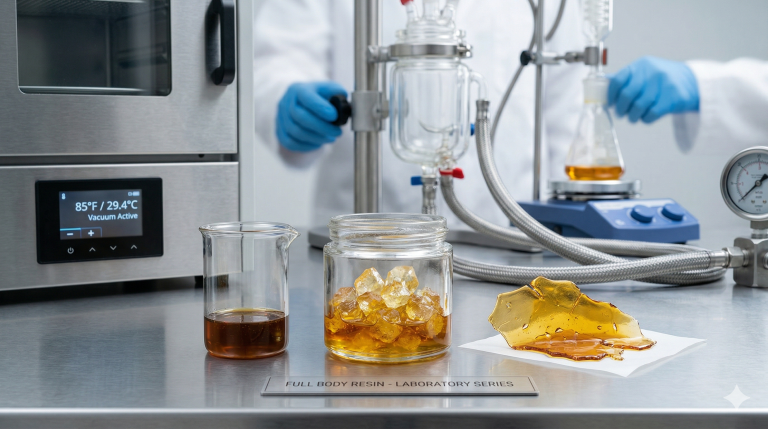
Full-spectrum resin products—such as live resin, cured resin, or rosin—are designed to retain the plant’s native chemical profile.
Key Characteristics:
- Preservation of volatile terpenes
- Retention of minor cannabinoids (<1%) that influence effect
- Inclusion of oxygenated compounds and flavonoids
- Minimal post-processing refinement
Unlike distillates, which undergo aggressive fractionation, full-spectrum resins aim to maintain chemical fidelity to the original biomass.
Extraction Implications
From an engineering standpoint, achieving true full-spectrum output requires:
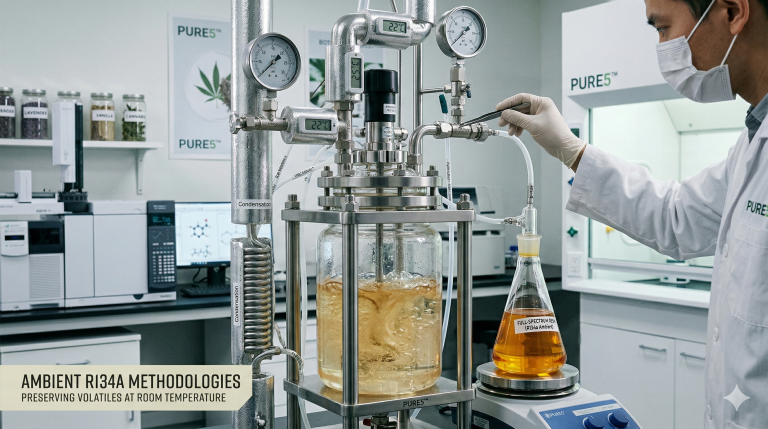
- Low-temperature extraction regimes (e.g., hydrocarbon or cryogenic ethanol)
- Controlled dewaxing/winterization without stripping minor compounds
- Avoidance of excessive distillation or chromatographic isolation
The goal is not maximum purity—but maximum chemical complexity with controlled refinement.
Traditional Distillate: Purity Without Complexity
Distillate production focuses on isolating cannabinoids—typically THC or CBD—through:
- Short-path or wiped-film distillation
- High-temperature fractionation
- Removal of terpenes and minor compounds
Resulting Profile:
- 85–99% single cannabinoid
- Near-zero terpene content (unless reintroduced artificially)
- Minimal minor cannabinoid presence
While distillates offer:
- Consistency
- Scalability
- Precise dosing
They fundamentally lack the multi-compound interaction layer required for the entourage effect.
Comparative Analysis: Entourage Effect vs. Isolation
1. Pharmacological Depth
Full-spectrum resins:
- Provide multi-target receptor interaction
- Enable modulation of THC effects by CBD and terpenes
- Create a broader therapeutic window
Distillates:
- Act primarily on single receptor pathways
- Often produce linear, less modulated effects
For example:
- CBD can reduce THC-induced anxiety
- Terpenes like myrcene may enhance cannabinoid permeability
2. Terpene Functionality
Terpenes are not just aromatic—they are bioactive compounds.
In full-spectrum resins:
- Terpenes remain native and strain-specific
- Influence absorption, mood, and neurological response
In distillates:
- Terpenes are often removed and later reintroduced
- Frequently derived from botanical (non-cannabis) sources
This leads to a loss of true biochemical synergy, even if flavor is restored.
3. Dose Efficiency
Studies indicate that full-spectrum extracts may achieve equal or superior effects at lower doses compared to isolates.
This is critical in both:
- Medical formulations
- Consumer product efficiency
Distillates, by contrast, often require:
- Higher doses
- More frequent consumption
4. Microbiological and Phytochemical Stability
From a botanical microbiology perspective:
Full-spectrum extracts:
- Retain natural antimicrobial terpenes
- Include compounds that may inhibit microbial growth
- Preserve oxidative balance within the extract
However, they also require:
- Stricter biomass quality control
- Proper post-extraction handling to avoid contamination
Distillates:
- Undergo thermal sterilization during processing
- Are inherently more microbiologically stable
- But lose biologically active minor compounds
5. Sensory and Experiential Profile
Full-spectrum resins:
- Provide strain-specific flavor and aroma
- Deliver a layered, nuanced effect profile
Distillates:
- Offer a more “clinical” or one-dimensional effect
- Often rely on added terpenes for flavor reconstruction
This distinction is critical for:
- Premium product positioning
- Consumer perception of quality
The Role of Extraction Technology in Preserving the Entourage Effect
Maintaining the entourage effect is not accidental—it is engineering-dependent.
Critical factors include:
- Temperature control → prevents terpene degradation
- Solvent polarity tuning → ensures broad compound capture
- Residence time management → avoids cannabinoid degradation
- Closed-loop systems → preserve volatile fractions
Advanced extraction systems are increasingly optimized not for maximum yield, but for maximum profile retention.
Industry Shift: From Purity to Complexity
The cannabis industry is undergoing a paradigm shift:
| Old Paradigm | New Paradigm |
|---|---|
| Maximum THC % | Maximum profile integrity |
| Distillate dominance | Resin and rosin growth |
| Standardization | Chemovar-specific products |
| Purity metrics | Entourage-driven efficacy |
This aligns with broader trends in:
- Functional medicine
- Botanical extraction science
- Consumer demand for “whole-plant” products
Conclusion
Full-spectrum resin products represent a biochemically complete expression of cannabis, preserving the intricate interplay between cannabinoids, terpenes, and other phytochemicals.
In contrast, traditional distillates prioritize purity over complexity, delivering isolated potency but lacking the synergistic depth associated with the entourage effect.
As research and extraction technologies advance, it becomes increasingly clear that:
The future of cannabis is not about isolating compounds—but about understanding and preserving their interactions.
For both medical applications and premium consumer products, full-spectrum resins are emerging as the gold standard, bridging the gap between plant science, extraction engineering, and real-world efficacy.